
Grief and Loss Counseling in Sun City, AZ: Support Through Later Life Loss
Grief is not something you get over. It is something you learn to carry, and carrying it gets easier when you are not doing it alone. At Sanity Center in Sun City, AZ, we provide grief and loss counseling in person for the West Valley and through secure telehealth for clients anywhere in Arizona. This guide covers what grief actually looks like, when professional support helps, how counseling works, and what to expect if you reach out. You can also learn more about our full range of mental health services in Sun City.
Key Points
There is no correct timeline. Grief does not resolve on a schedule, and the widely repeated five stages were never meant to be a sequence you pass through.
Grief is physical, not just emotional. Fatigue, appetite changes, sleep disruption, and cognitive fog are normal parts of bereavement.
Loss is broader than death. Losing your health, your independence, your driving privileges, or the home you spent decades in produces real grief that deserves real support.
Counseling is not about letting go. Modern grief work focuses on rebuilding a life around the loss while maintaining a connection to the person you lost.
Some grief does get stuck. Prolonged grief disorder is a recognized condition with specific, effective treatment.
We serve the West Valley in person and all of Arizona virtually, including Sun City West, Surprise, Peoria, Glendale, and beyond.
Grief Is Not a Problem to Be Solved
Most people arrive at grief counseling apologizing. They say they should be doing better by now. They say other people have had it worse. They say they do not want to be a burden. Underneath all of it is an assumption that grief is a malfunction, and that a well adjusted person should have processed it and moved on.
That assumption is wrong, and it causes an enormous amount of unnecessary suffering. Grief is the natural response to losing something you loved. Its intensity is a measure of the attachment, not a measure of your resilience.
The five stages model that everyone has heard of, denial, anger, bargaining, depression, and acceptance, was originally developed to describe the experience of people facing their own terminal diagnosis. It was never intended as a roadmap for the bereaved, and decades of research have not supported the idea that people move through grief in orderly phases. Real grief is far messier. It comes in waves. It circles back. You can feel genuinely at peace one morning and be flattened by a song in the grocery store that afternoon. None of that means you are doing it wrong.
Grief also is not limited to death. We have written before about grieving a life you never lived, the loss of a future you had counted on. That kind of loss is real too, and it often runs alongside bereavement rather than separate from it.
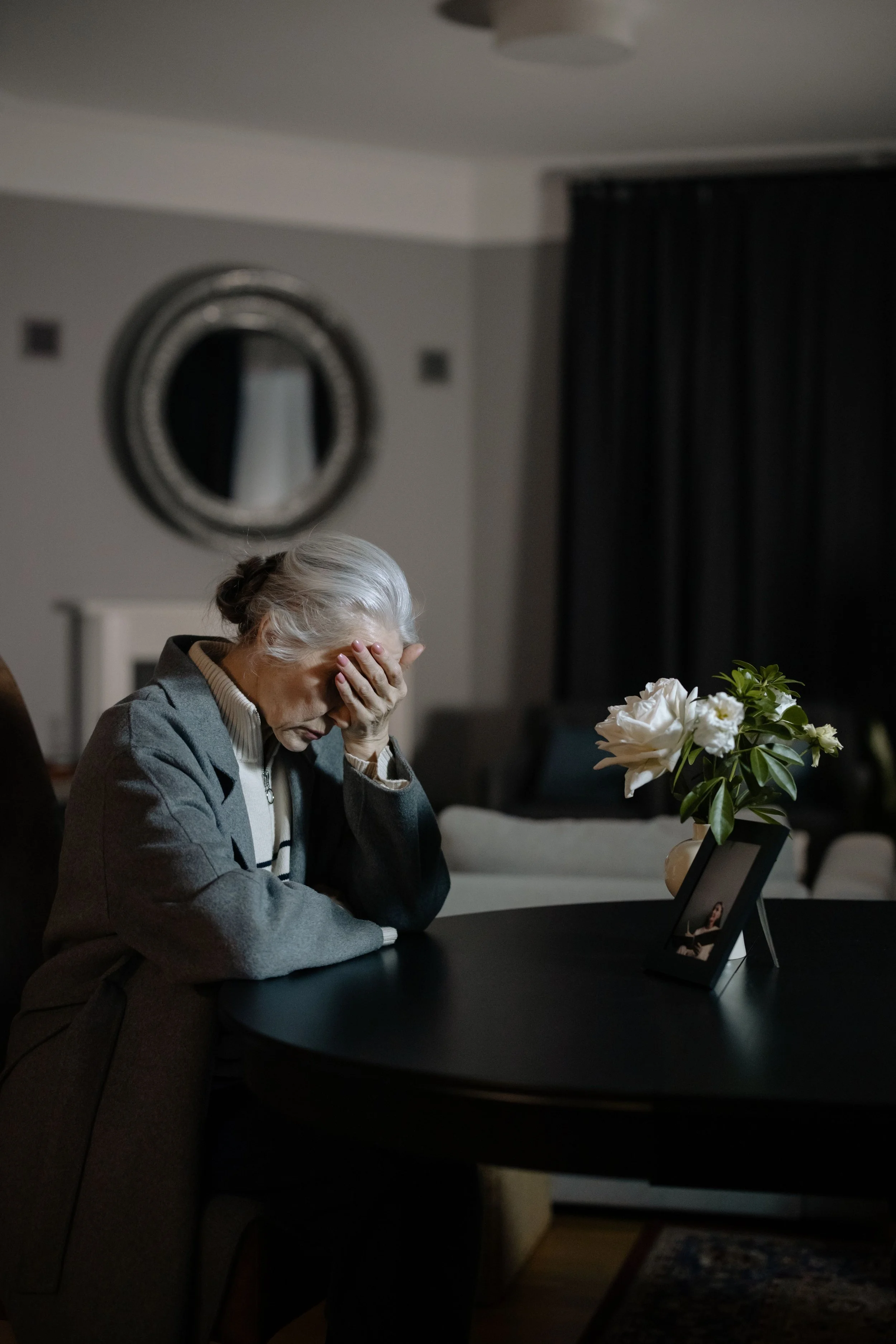
What Grief Actually Looks Like
Bereavement affects nearly every system in the body and mind. Recognizing the full range helps people stop pathologizing normal responses.
Emotional signs
Sadness, yes, but also anger, guilt, relief, anxiety, irritability, loneliness, and emotional flatness. Relief in particular carries a lot of shame, especially after a long illness or a difficult relationship, and it is one of the most common things people are afraid to say out loud. Feeling nothing at all is also common, and we cover that experience in our post on emotional numbness.
Cognitive signs
Difficulty concentrating, forgetfulness, disorientation, trouble making decisions, and a persistent sense of unreality. Many grieving people worry they are developing dementia. In most cases what they are experiencing is the cognitive cost of acute grief, which improves with time.
Physical signs
Exhaustion, chest heaviness, appetite loss or increase, headaches, muscle aches, weakened immune response, and disrupted sleep. Grief activates the same stress systems as any other major threat, which is why it takes such a physical toll. Our article on mental health and the nervous system explains that connection in more depth.
Behavioral signs
Withdrawing from people, avoiding places associated with the person, or the opposite, staying relentlessly busy to avoid sitting still. Some people cannot bear to change anything in the house. Others need to clear everything out immediately. Both are ways of managing the same pain.
Types of Loss We Work With
Loss of a spouse or long term partner
After forty or fifty years, losing a spouse is not only the loss of a person. It is the loss of your daily structure, your shared language, your default plan for every evening, and often your primary source of practical help. Many surviving spouses describe feeling like they lost their own identity alongside their partner. Practical burdens tend to land immediately as well: finances that one person always handled, a house that suddenly takes two people's work, medical appointments without an advocate in the room.
Anticipatory grief and caregiver loss
Grief frequently begins long before death. Watching a spouse decline through dementia, cancer, Parkinson's, or heart failure means grieving in installments, losing pieces of the person while still caring for them daily. Caregivers often reach the death already depleted, then feel guilty for the relief that accompanies the sorrow. If you are in this position now, our post on the invisible load carried by caregivers speaks directly to it.
Losing a parent as an adult child
This loss gets minimized constantly, both by others and by the person experiencing it. The reasoning goes that it was expected, that they lived a full life, that this is the natural order. All of that can be true while the loss still knocks you sideways. For many adults it is the first time they experience themselves as the oldest generation, which carries its own weight.
Losses that are not deaths
Grief follows any significant loss of what mattered to you. Giving up driving. A diagnosis that changes what your years ahead will look like. Selling the family home. Losing mobility, hearing, or vision. Watching a friend group thin out year after year. These losses often go unacknowledged because there is no funeral and no casserole, which can make them lonelier than a death. Our article on the science of aging covers some of these transitions in more detail.
Complicated and disenfranchised grief
Some losses are harder to grieve openly. The death of an estranged family member. Losing a partner in a relationship others did not recognize. Grief after suicide or overdose, where stigma silences people. A death that arrived alongside an unresolved conflict. These situations benefit particularly from a setting where you can say the complicated things without managing anyone else's reaction.
When Grief Becomes Prolonged Grief Disorder
Most people, given time and support, gradually find that grief becomes less consuming even though it never disappears entirely. For a smaller group, roughly one in ten bereaved adults by most estimates, grief stays acute and disabling rather than easing.
Prolonged grief disorder was formally added to the DSM-5-TR in 2022. In adults it is considered when intense grief persists beyond twelve months after the death and includes symptoms such as:
Persistent, intense yearning or longing for the person who died
Preoccupation with thoughts or memories of them that crowds out everything else
A sense that part of yourself has died
Marked difficulty accepting the death
Emotional numbness or an inability to experience positive feelings
Avoidance of reminders, or the opposite, an inability to leave reminders alone
Intense loneliness and a feeling that life has become meaningless
Significant difficulty resuming relationships, activities, or plans
This is not a judgment about grieving too much or loving too deeply. It is a recognizable pattern with treatments developed specifically for it, and those treatments work. If your grief has not shifted at all in more than a year, that is worth bringing to a professional rather than waiting it out. We generally encourage people not to wait until they are at a breaking point, a point we make in our article on seeking mental health support in Arizona before a crisis.
How Grief Counseling Works
Grief counseling is not designed to make you stop missing someone. It is designed to help you build a life that has room for both the loss and a future.
A place to say the true things
Many grieving people spend enormous energy managing everyone else's discomfort. They reassure their adult children. They give the acceptable answer at church. They stop mentioning the person's name because it makes the room go quiet. Therapy is one of the few places where none of that management is required, and that alone accounts for much of the relief people report. We explore why this matters in Healing Conversations.
Continuing bonds rather than letting go
Older models of grief work emphasized detachment, severing the connection so you could move on. Current research points the other direction. Healthy adaptation usually involves maintaining a relationship with the person who died in a changed form: talking to them, keeping traditions, carrying their values forward. The goal is a connection that sustains you rather than one that keeps you stuck.
Meaning reconstruction
A major loss disrupts the story you were telling about your own life. Much of grief work involves rebuilding that narrative: who you are now, what your days are for, what you want the years ahead to hold. This is slow work, and it is often the part that produces the most durable change.
Cognitive and behavioral approaches
When grief is tangled up with guilt, self blame, or replaying the final weeks looking for what you should have done differently, structured cognitive work helps. So does gradually reengaging with avoided places and activities, at a pace you set. Avoidance provides short term relief and long term entrenchment.
EMDR for traumatic loss
When a death was sudden, violent, or witnessed, or when intrusive images of the final hours will not stop, the loss carries a trauma component that ordinary grief support does not reach. In those cases we may use EMDR to reduce the charge on those memories so that mourning can proceed without being repeatedly interrupted by them.
Grief, Sleep, and the Body
Sleep is often the first thing to go and one of the most important to address. Waking at the hour you used to wake together. An empty side of the bed. Nights that were always the hardest part of the day now stretching without end. Sleep deprivation then amplifies every other grief symptom, deepening the fog and shortening the emotional fuse.
Basic nutrition and movement matter for the same reason. Nobody grieving needs a wellness lecture, but small, achievable anchors, a short walk in the early morning before the Arizona heat arrives, one real meal a day, a consistent bedtime, provide real stabilization. Our guide to restorative sleep for Arizonans offers practical starting points.
Medication: When It Helps and How We Coordinate
We do not prescribe medication at Sanity Center. Our clinicians are licensed therapists, and prescribing is outside our scope of practice. It is worth understanding the option regardless.
Grief itself is not a condition that medication treats. There is no drug that shortens mourning, and normal bereavement generally should not be medicated away. What medication can address is a co-occurring condition that grief has triggered or worsened: a major depressive episode, severe insomnia, or an anxiety disorder that has become disabling. In those situations, treating the co-occurring condition often makes it possible to actually engage in grief work rather than being too depleted to do so.
If medication is something you want to explore, we can help provide you resources to assist you in finding a prescriber, whether that is your primary care provider, a psychiatrist, or a psychiatric mental health nurse practitioner. With your written consent, we can communicate directly with them, sharing relevant observations about your symptoms, sleep, and progress, and helping you prepare for appointments that are often brief. You control what is shared and can withdraw that consent at any time. If you would rather not pursue medication, that decision is fully respected.
Grief Counseling in Sun City and the West Valley
Our office is in Sun City, AZ, and we see clients from across the West Valley including Sun City West, Sun City Grand, Surprise, Peoria, Glendale, El Mirage, Youngtown, Litchfield Park, Goodyear, Avondale, and Buckeye.
Grief in a retirement community carries specific features that we see constantly. Many residents moved here from somewhere else, which means the loss arrives at a distance from adult children, lifelong friends, and the church or community that would otherwise surround you. The couple who moved here together made this a shared project, and one of them is now living inside that project alone. Friend groups here also experience loss at a rate that would be unusual anywhere else, producing a cumulative grief that rarely gets named. We touched on some of this in Life Transitions in Every Season, written as we settled into this community ourselves.
We also see the practical side clearly: the surviving spouse who never handled the finances, the widow who stopped driving at night and now cannot get to evening gatherings, the widower whose entire social life ran through his wife's calendar. These are grief issues, not just logistics, and they belong in the room.
Virtual Grief Counseling Anywhere in Arizona
Our clinicians are licensed in Arizona and can provide telehealth to anyone located in the state, including Phoenix, Scottsdale, Mesa, Tempe, Chandler, Gilbert, Tucson, Flagstaff, Prescott, Yuma, Lake Havasu City, and rural areas where grief specialists are scarce.
Telehealth removes obstacles that grief itself creates. In the early months, getting dressed and driving across town can be more than someone can manage. Summer heat limits travel for many Arizona residents. Some people simply cannot face a waiting room yet. Being able to attend from your own living room is frequently the difference between getting support and going without it.
Paying for Grief Counseling and Getting Started
Before booking anywhere, ask about accepted insurance, self pay rates, sliding scale availability, session length, and whether superbills are provided for out of network reimbursement. Our article on therapy costs, insurance, and superbills explains each of these plainly.
Fit matters, particularly for grief work, where you need to feel safe saying things you have not said to anyone. Our guide to finding the right therapist covers what to look for and what to ask.
To begin, call 623-986-8460 or use the contact form on our site. We will ask a few brief questions, answer yours, and get you scheduled. If we are not the right fit, we will say so and help you find someone who is.
Key Takeaways
Grief has no correct duration, and the stages model was never meant to be a sequence.
Cognitive fog, exhaustion, and physical symptoms are normal parts of bereavement, not signs of decline.
Non-death losses such as health, independence, and home produce genuine grief that deserves support.
Counseling aims to help you rebuild around the loss while keeping a connection to the person, not to make you let go.
Prolonged grief disorder is real, recognized, and treatable when grief stays stuck past a year.
Medication does not treat grief itself but can address depression, anxiety, or insomnia that grief has triggered, and we coordinate with your prescriber if you choose that route.
Frequently Asked Questions About Grief Counseling
How soon after a death should I start counseling?
There is no required waiting period. Some people benefit from support within the first weeks, particularly if the death was sudden or traumatic or if they are isolated. Others prefer to wait until the initial flood of activity settles. Both are reasonable. If you are wondering whether it is too soon, it usually is not.
Is it normal to still be grieving after a year?
Yes. Most people continue to feel grief well past the first year, particularly around anniversaries, birthdays, and holidays. What matters is whether the grief has begun to shift at all, allowing moments of engagement with life alongside the sorrow. If nothing has moved, that is worth discussing with a professional.
Will counseling make me forget my spouse or stop missing them?
No, and that is not the goal. Grief counseling helps you carry the relationship forward in a form that supports you rather than one that stops your life. Most clients end treatment feeling more connected to the person they lost, not less.
Do you offer grief support groups?
We do not at this time. Individual counseling and group support serve different purposes and work well together. Groups reduce isolation and normalize the experience. Individual work goes deeper into your specific circumstances, relationship history, and any complicating factors. However, we can help in providing resources for groups that could assist with grief support.
What if my grief is mixed with anger or relief?
That is extremely common and does not mean anything is wrong with you. Complicated relationships produce complicated grief. Long illnesses produce relief alongside sorrow. Therapy is a place to sort through those feelings without being judged for them.
Can grief counseling help if the loss was years ago?
Yes. Some people carry unresolved grief for decades, often from a loss that occurred when they lacked the space or support to process it. It is never too late, and older losses frequently respond well once they are finally given attention.
Is grief different for older adults?
In some ways. Later life grief often involves losses that accumulate, longer relationships, and more practical disruption. It also carries a higher risk of isolation. At the same time, many older adults bring decades of experience with adversity to the work. Our article on The Golden Mind explores mental health in later life more fully.
When should I be worried about myself?
Reach out to a professional if you are unable to care for basic needs, using alcohol or medication to get through days, completely isolated for weeks, or experiencing thoughts of not wanting to be here. If you are having thoughts of harming yourself, or someone else, call or text 988 for the Suicide and Crisis Lifeline, available at any hour.
What areas do you serve?
In person from our Sun City office for the West Valley, and virtually for anyone located anywhere in Arizona.
References and Resources
National Institute on Aging, Grief and Mourning. nia.nih.gov/health/grief-and-mourning
Center for Prolonged Grief, Columbia University. prolongedgrief.columbia.edu
American Psychological Association, Grief and Loss. apa.org/topics/grief
Hospice Foundation of America, grief education and resources. hospicefoundation.org
Hospice of the Valley, Phoenix area bereavement services available to the community. hov.org
National Alliance on Mental Illness, Arizona. namiarizona.org
988 Suicide and Crisis Lifeline. Call or text 988. 988lifeline.org
Arizona Department of Health Services, Behavioral Health Services. azdhs.gov/behavioral-health
This article is intended for general education and does not constitute medical advice, diagnosis, or treatment. If you are experiencing a mental health emergency, call 911 or call or text 988.
You do not have to carry this alone. Sanity Center provides grief and loss counseling in Sun City, AZ, serving the West Valley in person and all of Arizona through secure telehealth. Call 623-986-8460 or visit www.sanitycenter.org to schedule.